Showing posts with label Puebla. Show all posts

Monday, March 9, 2015

Me nombre es lucha


Movement for Peace, Justice and Dignity is a non-violent group of Mexicans that fights against the Mexican government that began in 2011. Like the Zapatista movement, this movement does not use 
bullets to fight, they use words.

Over the past decade the Mexican government has been responsible for killing 100,000 people, 10,000 have been displaced and no one knows how many people have gone missing because of violent crimes. 

Today, on average, 1,800 people are killed each month by the Mexican government. During a discourse with a young, Mexican organizer, someone from our group asked him if he was scared to organize against the violent government. He quickly said, “No”. Then he explained the difference between being scared and being terrified. To be scared is to be alert, having all senses open, always moving around and on the go. To be terrified, on the other hand, paralyzes people. Then, he paused before saying that it is good to be scared and the fear motivates him. The fear does not stop him. 

So, what can we do? What can we do as Americans to help the Movement for Peace, Justice and Dignity in Mexico and around the world? I think it starts with knowledge. Knowledge of the truth and the reality of what is happening in Mexico. 

...Me nombre es lucha


Me nombre es lucha...

Movimiento por la Paz y Justicia Dignidad (MPJD) es un grupo de no violencia contra el gobierno de México que empezó en 2011. Como el movimiento de las Zapatistas, no usan balas para luchar. En cambio, usan palabras. 

En la última década, más o menos, había 100,000 muertos por la culpa del gobierno mexicano, 10,000 personas han sido desplazados, y nadie sabe cuantas personas han estado desaparecidos por causas de violencia. Todavía, hoy en día, promedio de 1,800 personas se encuentran muertos cada mes. Durante una discurso con un organizador, alguien le preguntó si tiene miedo organizando contra la violencia. Le dijo, “No”. Entonces explicó la diferencia entre tener miedo y tener terror. Tener miedo es estar alerto, todos sentidos abiertos, siempre moverse adelante. Tener terror, en el otro mano, paraliza la gente. Pues, es bueno tener miedo. En este sentido, es mejor tener miedo.

Entonces, ¿Qué podemos hacer? ¿Qué podemos hacer para ayudar los intentos de los movimientos de paz in México y en el mundo? Creo que empieza con conocimiento. Conocimiento de la verdad y realidad de que esta pasando.

…Me nombre es lucha

*Originally posted by Terri Shelton on August 29, 2014 at: http://gsswblog.du.edu/globalpractice/2014/08/29/me-nombre-es-lucha/

Friday, March 6, 2015

The Power of Listening


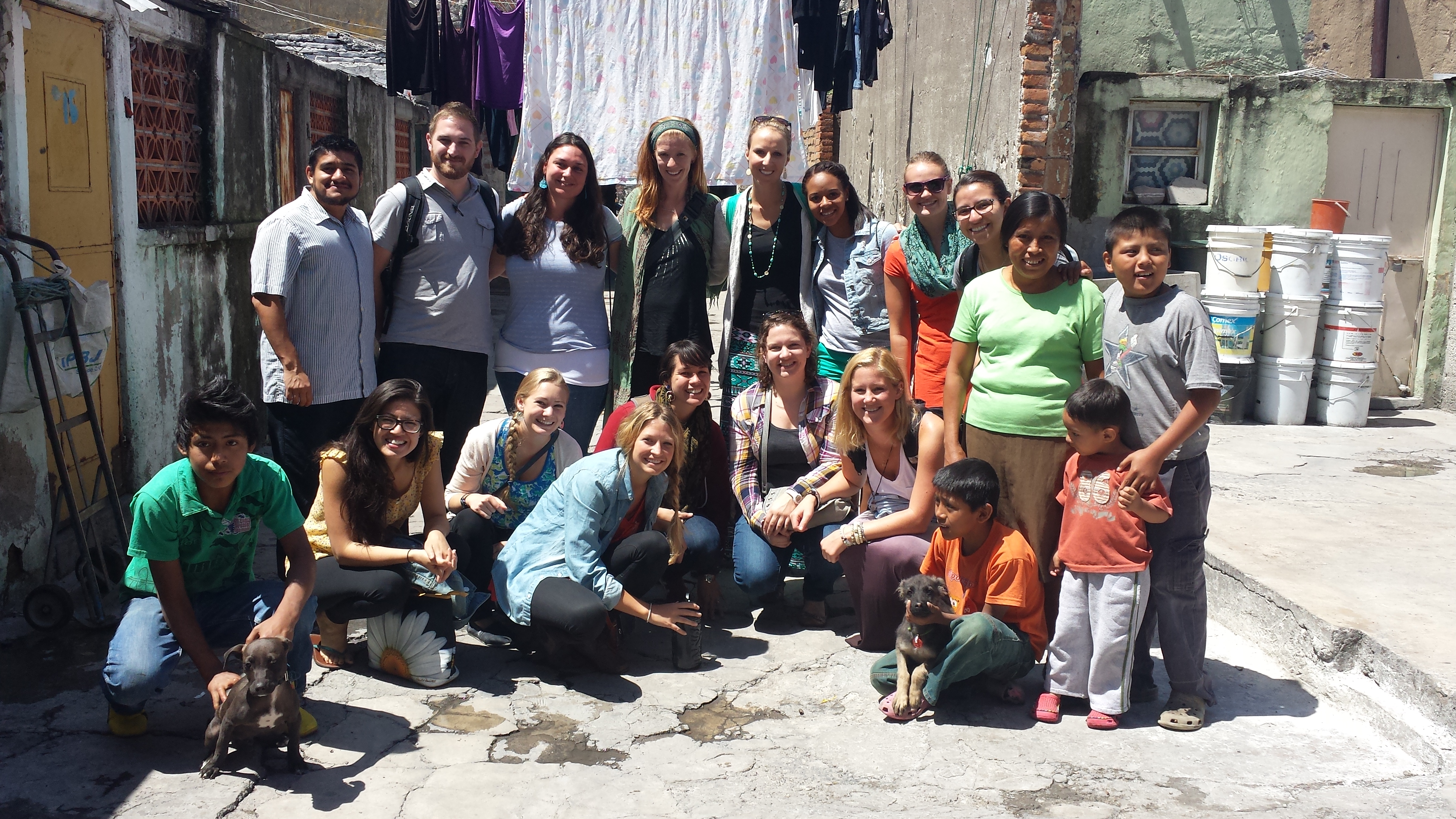
The Latino Certificate group with one of the families (and their adorable puppies Chito and Osito) that invited us into their homes
The Latino Certificate group with one of the families (and their adorable puppies Chito and Osito) that invited us into their home
We have had so many impactful interactions with such wonderful people in the eight days we’ve been in Puebla so far that it is difficult to pick one to write about in this second post. That said, I think I’ll talk about two of the most humbling experiences for me so far. This past Sunday we went to visit two families in one of the most impoverished neighborhoods in the city of Puebla. To give you an idea of the level of poverty they are struggling with, the monthly rent at their homes comes to about $76.40 and $114.61 respectively. To those of us who live in the U.S. that seems like absolutely nothing, but it is a struggle for these women and their children to come up with that money because their only form of income is selling food they make on the street. On a good day one of the women said they might make 100 pesos, which is around $7.65 to give you some perspective on how difficult it is to earn enough for rent on a monthly basis. On top of rent they need to buy food for themselves and pay their electric bill every two months, not to mention clothes and other things they might need. Sending their children to school also costs around $114 a year per child and there are no free and reduced lunch programs in Mexico, so they must send food with them to school every day as well. At ten and twelve years old the kids start contributing, which they are happy to do because supporting themselves is a collective, family effort. As real as their struggles are, they also feel blessed that their families are still together because so many others have to separate out of economic necessity and are often never reunited.
Sitting in these families’ one room apartments on chairs they insisted on finding for all fifteen of us, I couldn’t help but feel unbelievably ungrateful for ever complaining about the extremely easy life I’ve led. This wasn’t the first time I’ve thought about how fortunate I am, but it is one of the only times I’ve been confronted with it in person by hearing these women and their children’s stories—listening, asking questions and connecting with them as a fellow human. It’s one thing to be aware that extreme poverty like that exists & discuss it in the confines of a classroom and an entirely different experience to see and talk to the people living it day in and day out.
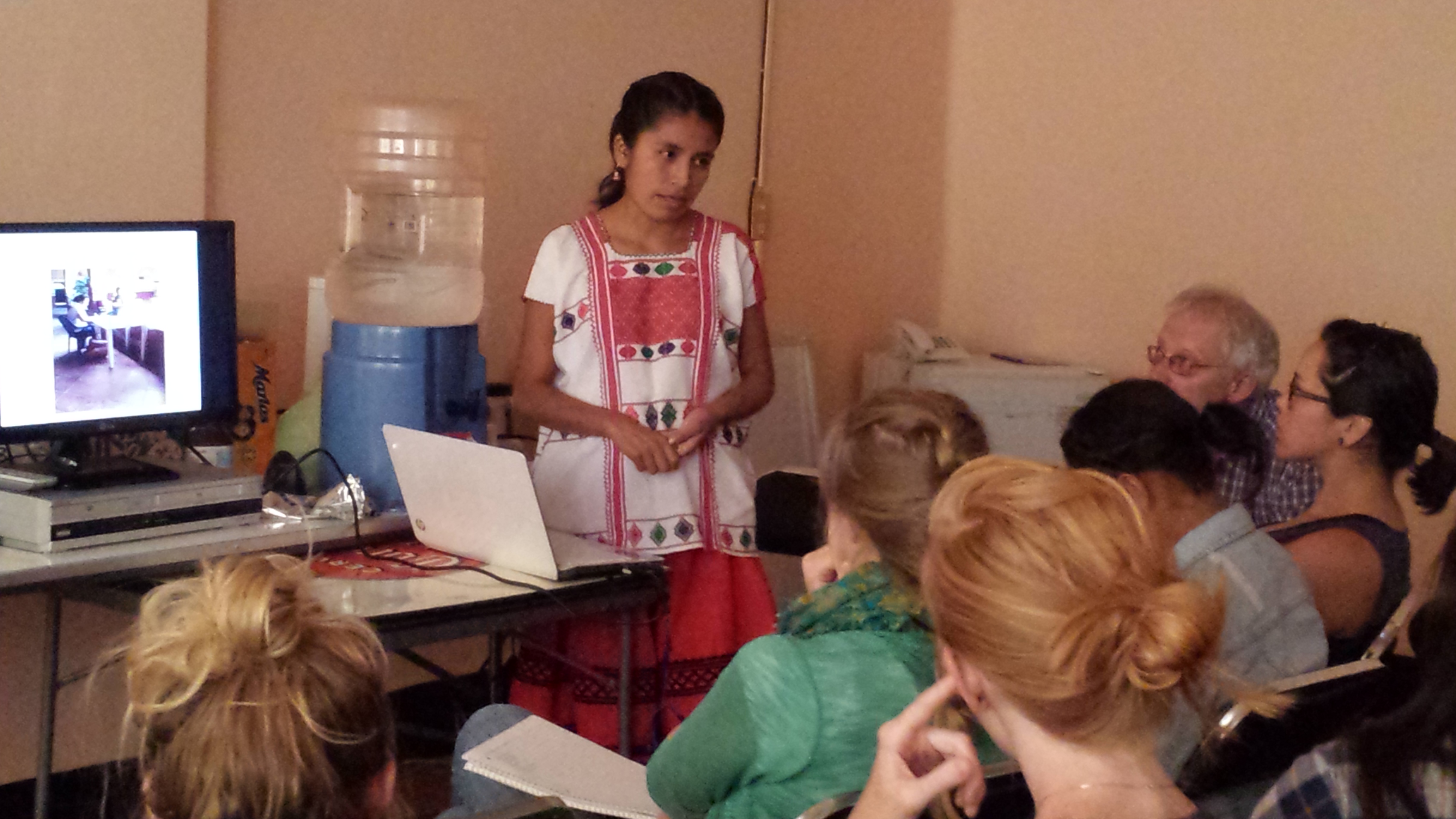
Estela talking to us about her pueblo, Cohoapa el Grande
Another powerful and humbling interaction was hearing a young woman named Estela from a tiny mountain pueblo called Cochoapa el Grande—the poorest municipality in the state of Guerrero—talk about her mission to bring the most basic of necessities to her village. It is three-four hours from the nearest city of Tlapa and does not even appear on a map. The children there only have classes three days a week because it takes the teachers a full day to get there and back and they don’t like staying there for longer than that. Many of the people living there have no form of identification because they were born in the mountains and never received a birth certificate, so according to the Mexican government they don’t exist. There is one clinic in the village for 1,975 inhabitants which often overwhelms the one doctor, three nurses and three interns. If you need to see a specialist or get a specific kind of medication you have to make the three-four hour trek to Tlapa and it isn’t uncommon for people to die on the journey. One of us asked if there was access to clean water nearby and she said it wasn’t far at all—they only had to walk an hour to get to the river and then boil the water before they used it. Estela is fighting to further her education and get better educational access for those in her village & effective social services without much familial or community support. I couldn’t help but think during her talk that she is so much braver and stronger than I could ever hope to be. I have never had to fight for the things I believe in like she has or needed the confidence she has in what I believe in to not be deterred when very few people support me. And she does all this with the utmost respect for her culture and village—she just wants their lives to be better in the most basic ways.
After gaining all this new knowledge, I am continually thinking about what it will be like going back to my daily life in the States. I am envisioning I will find it difficult being forced to care about the things that used to seem so important and being surrounded by people who don’t know or simply don’t care about these real and pressing issues. I also worry that I’ll get caught up in myself and school again and let all of this knowledge and anger go, becoming complacent because caring is too hard. However, I also sense that I may have reached the point of no return—I can’t go back knowing what I know now; this experience will never leave me. I hope I can rely on and invest in the support of my classmates on this trip with me and maintain the closeness we’ve developed because of this shared experience. So, instead of getting overwhelmed by all the change that needs to happen, I am going to focus on something small I can do every day to chip away at all the grand social problems looming in front of me. I’m done waiting for something in my life to change so I feel ready to act—the time is now and I can’t do it alone. ¡Si se puede!

*Originally posted by Maddy Mitchell on August 28, 2014 at: http://gsswblog.du.edu/globalpractice/2014/08/28/now-what

Choosing Awareness


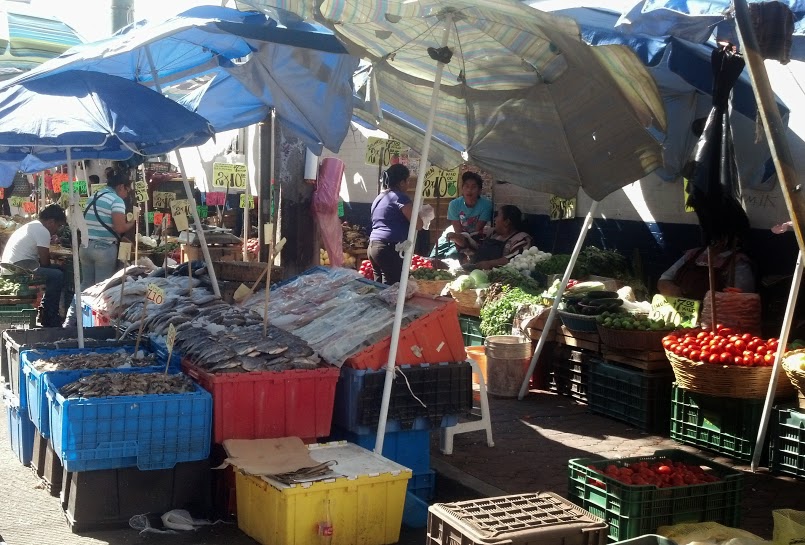
mercado Cinco de Mayo
El Mercado Cinco de Mayo in the city of Puebla
As a group of social work students who are a part of a Social Work with Latinos Certificate at the University of Denver Graduate School of Social Work, we have done a lot of self-reflection since arriving in Puebla, Pue.—Mexico to learn more about the Mexican culture and its people. Although I have been passionate about doing the certificate and working with the Latino population in Denver all along, I had trouble verbalizing why I was coming to Mexico and what the exact purpose of our trip was. Now after just a few days here in Puebla, I understand how critical this experience is for my development as a social worker and as a white American in particular. We´re only here for two weeks, which is no time at all but even this short stint of cultural immersion is going to be critical in helping me become a part of a movement for social change in an effective and genuine way. As a social work student, I have come to understand the importance of cultural competence—not assuming you have all the answers or know about every aspect of another person´s culture and beliefs, and also being respectful of that culture and not imposing your own beliefs and values on anyone else. But just like I think it is difficult to learn a language unless you are living in a place where you can completely immerse yourself in it, I think it would have been incredibly difficult to feel at all culturally competent when it comes to working with Latinos without this experience in Puebla. Obviously, I am only in one place talking to and interacting with a small percentage of people who are not representative of all Mexicans, but it is still so valuable to witness and hear about the problems and pain & suffering that are causing so many people to migrate to the United States. My hope is that this new knowledge and understanding will make me both a more empathetic and culturally competent social worker.
una calle de Puebla
a typical street in the city of Puebla
One of my biggest takeaways from this experience thus far is that as Americans we are unbelievably lucky simply to live in a country where we can fight for social change without the fear of death. The corruption and government control is so extensive here in Mexico that speaking out against the oppressive conditions automatically puts you at risk. There are a lot rights like free speech that feel so basic to us and we take for granted on a daily basis. So many of us are completely ignorant to how bleak the economic and social conditions are in Mexico and they are our neighbors! Seventy percent of the Mexican population lives in poverty. The unemployment rate here is a whopping fifty percent (highest in the world) compared to roughly a mere seven percent in the U.S. Although it has improved, the general consensus is that our job situation is pretty bleak. Imagine what life would be like for the majority of us if our unemployment rate was that high! Hearing these shocking statistics makes me wonder if our ignorance is chosen. If more people knew them, along with the role the U.S. has played in creating the situation, would there be increased empathy for the stream of immigrants coming to our country just to survive?
What I am realizing is that as social workers, especially those of us interested in community organizing and advocacy, it might be our job to educate the general population on such social injustices. It´s a job I am whole-heartedly committed to taking on, but I still wonder if it´s possible for me to genuinely be a part of the solution when I am passively part of the problem as a white American leading a very privileged life. I think the key is to treat my job as a future social worker as a process I continually approach with a sense of humility and desire to learn from those I am working with instead of on behalf of. If we have any chance of creating any real, lasting social change a sense of cooperation and continuous exchange of knowledge & ideas is absolutely crucial.

*Originally posted by Maddy Mitchell on August 24, 2014 at: http://gsswblog.du.edu/globalpractice/2014/08/24/choosing-awareness